Letters from the Light: A Lighter November. Day Three

Letters for a Lighter November
Thoughts, practical ideas and weekend writing prompts to make the darker days a little easier.

Closing Loops

On Monday, we looked at that feeling of the day being almost over before we’ve finished with it. On Wednesday, the negotiations our minds get us involved in before we can even contemplate leaving the house.

But what about when we do stay home? We’ve got the comfies on, nowhere we need to be, nothing particularly urgent to do. This is what we wanted. So why aren’t we enjoying it?

Our body’s tired, but our head has apparently been waiting for this opportunity, and off it goes: maybe I should do that thing I’ve been avoiding; if I just vacuum now it’s done; should I make the most of this time and finish that work thing…

Layer that on top of what am I missing, will they ever ask me again, I wish I’d gone now, and eventually you go to bed, having spent an evening supposedly resting, and now we don’t feel rested at all.

What’s happening in the brain and body?

Being tired and being ready to power down for the night aren’t always the same thing. We can need sleep while still feeling mentally wired or worried. Stress can make falling asleep harder, or set off the wake-up alarm at 3am again, however exhausted we are.

Stopping an activity doesn’t automatically stop the thinking that went with it either. We’ve finished working, but we’re still rehearsing or examining something that really could wait. We’ve put our phone down, but we’re still comparing our life with something we saw on it that looked more like the one we want.

With longer evenings indoors, there can be more opportunity to notice all this. The quiet hasn’t necessarily created the thoughts: sometimes it’s simply the first chance they’ve had to be heard loud and clear. We know this: things get really loud inside when outside is quieter. Hence 3am.
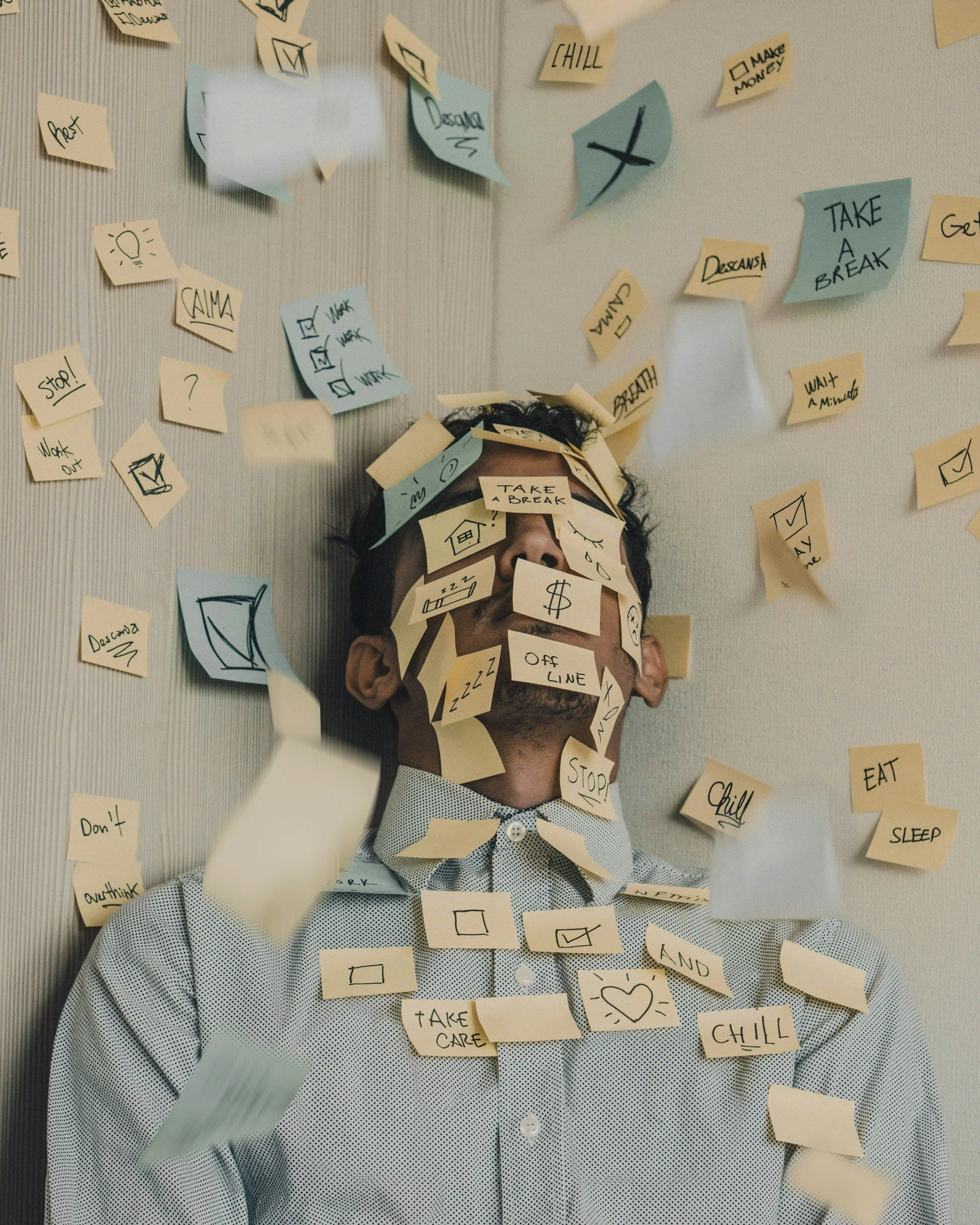
Post-it notes written to our brain don’t always cut it…

And psychologically?

Sometimes we sit down with an expectation: right, I’ve stopped now, time to wind down. I should feel better.

Then we start fidgeting. Am I relaxed yet? Why am I still tense? Am I wasting my evening? Should I be doing something more useful? Rest becomes another thing we’re trying to get right. Great.

There can be guilt, too. The feeling that we haven’t done enough to deserve stopping, even when we’re too tired to do anything well. Or we keep ourselves occupied because being busy feels easier than being alone with whatever we’re feeling.

It helps to notice the difference between thinking something through and going round it again on our familiar perpetual loop without actually coming to a conclusion. Has anything become clearer? At all? Is there a decision, a next step, a different understanding? Or have you arrived back at the same question, feeling worse?

More time spent thinking doesn’t always bring more understanding.  One thing I’ve noticed is that open loops cause the anxiety and restlessness that gets in my way: Have I actually decided anything?  Why not?

Making decisions is hard because we’re scared we’re about to make the wrong one: I could have, I should have… We’ve lost trust in ourselves.

Self-trust is a habit, something you re-learn.  We start by making one decision and seeing what comes of it, knowing that we can cope with, manage, work through, whatever the result is.
Make a decision…no matter the outcome.

Three ways to make this easier

1. Give the unfinished things a stopping point.

Before settling down, take ten minutes to note what’s still occupying you. A practical problem might need one next step: make the call tomorrow, check the date, ask the question.

Some things won’t have an action you can take tonight. Acknowledge that too. You can care about something without spending the whole evening trying to solve it.

A short period of ‘worry time’ to work through concerns might work for you, rather than letting them take over the evening or bedtime.  Or maybe you practice just not having the answer and being ok with that too – just for tonight.

Work out which works for out by trial and error: you won’t know until you’ve experienced different ways of settling.

2. Ask what would actually feel restful tonight.

Quiet? A chat by phone or text with someone? Moving after a day at a desk? A break from answering questions? Something enjoyable that doesn’t require you to make another decision?

The answer won’t always be an early night: maybe it’s actually something that fits what you’ve noticed: a familiar piece of music, a gentle walk, a shower, an audiobook, making something with your hands. TV can be enjoyable too. Notice whether you’re enjoying what you’re watching or endlessly searching for something that might change how you feel.

Doing two things at a time? Knit with TV, read a book with good music.  Maybe cleaning up the kitchen is what you need but make it mindful – allow it to settle your nervous system, knowing that tomorrow morning, there’ll be no mess!

It’s personal: what feels genuinely good to you? What about today? Where are you in your cycle? Was the day hard and so requires something different? Noticing the things that work is how you build up your own kit of personalised tools

Top Tip: Give one thing a little time before deciding it hasn’t worked.

3. Let settling take a while.

You don’t have to become perfectly calm before an evening counts as restful. You’re not buddha.  But you can practice and learn new ways of being.

Mindfulness really does help: presence really does make a difference to how active your mind is. Feel the chair supporting you. Watch your own hands. Let your jaw loosen if it’s clenched. Look around the room and notice a few ordinary things. If focusing on your breathing feels comfortable, let it become a little slower without forcing a huge breath.

When your thoughts wander back to the problem, just notice, and return to what you were doing. You may need to do that several times. No one has a perfectly still and quiet mind: the plan is to practice coming back to the present moment, the stillness until it becomes something that works.

For tonight: Your Intention.

Before choosing how to spend the evening, ask yourself:

What am I hoping this will do for me?

Help me feel less alone? Give me pleasure? Distract me for a while? Help me sleep?

Knowing what you need gives you a better chance of finding something that helps.

Sunday’s thinking / writing prompt will give you space to look back over the week: the darkness, the changes in energy, and the habits we slip into when autumn arrives. Sunday is reflection & writing day.  It’ll be with you by 11am so you can spend your day with it.

Would you rather get these letters straight to your inbox? Here

Next
Next

Letters from the Light: A Lighter November. Day Two.